
Who gets your hours?
Work takes the day. Scrolling takes the gaps. Gaming takes the evening, shopping takes spare money, a drink unwinds you and a coffee restarts you. Set your own day, then count what each habit costs.
- The Daytakes its share first
- Leestopped, still pulling
- The Feedsells you the pause
- Maxasks, then counts
Headphones help: The Day speaks from your far left, Max from your far right.
Who gets your hours01 / 08
One body. One budget. 24 hours.
Every habit draws from the same day. Move the sliders to your own day.
Nothing you type here leaves your phone.
Who gets your hours02 / 08
A benefit does not erase a cost.
Every name on the front is true some of the time. Tap a card to see what the name stops you from counting.
The sweet one, on the record
- Under 10% of daily energy from free sugars, ideally under 5%, about six teaspoons. Free sugars are the most common risk factor for tooth decay. WHO
- Hooked? A 2016 review found little evidence of sugar addiction in humans; addiction-like eating research looks at highly processed food that pairs refined carbs with fat. Westwater · review
- +500 calories a day. Twenty adults on an ultra-processed diet ate about 500 more calories a day than on an unprocessed one, and gained close to a kilo in two weeks. NIH trial
Who gets your hours03 / 08
Relief is real. The problem can remain.
The loop never feels like a decision. Step through it.
- CueA buzz, a time of day, a bad mood.
- WantingYou can feel it before you've done anything.
- Do itOne clip. One match. One glass. One cart.
- ReliefNot joy, mostly. The edge comes off.
- AgainThe relief wears off, and the cue is waiting.
Times around: 0
Alcohol research describes a three-stage cycle: binge and intoxication, negative affect and withdrawal, preoccupation and anticipation. The wanting can stay strong after the enjoyment fades. NIAAA · review
Physical dependence is not the same thing as addiction. A patient on prescribed medication can have withdrawal without being addicted, and a game has no chemistry at all and can still take over. The tell is the gap: you decide to stop, again and again, and the urge keeps winning while the cost is already in view. NIDA
Who gets your hours04 / 08
Knowing the cost is one step.
Pick a habit, then tap every place it costs you. Your own goals are the baseline.
The World Health Organization's test for gaming disorder has the same shape: impaired control, the game taking priority over everything else, and carrying on despite the damage, normally for at least a year. WHO
Who gets your hours05 / 08
The cost doesn't end when you quit.
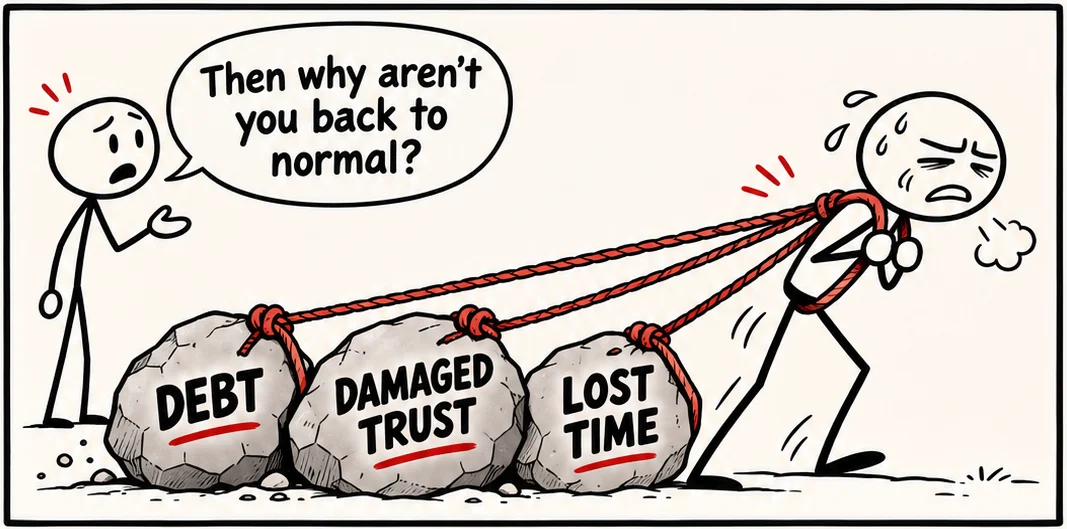
Each rock runs on its own clock. Tap one.
Debt runs on the lender's clock. Quitting doesn't pause the interest.
Trust runs on kept promises, and it only counts them one at a time. Nobody can pay it back in a lump.
Lost time doesn't run back at all. It uses the hours from your dial.
Quitting and recovering run on different clocks.
The people around you carry some of it too. For gambling, the World Health Organization estimates that each person gambling at high risk affects about six others, usually people who don't gamble. WHO
Who gets your hours06 / 08
Who keeps the books?
The same evening, written up twice. Switch the ledger.
- Revenueup
- Retentionup
- Session lengthup
- Repeat purchasesup
- Sleepdown
- Money left on Fridaydown
- Time with peopledown
- Doing what you decideddown
Those numbers say how the business is doing. They don't say how the customer is doing. WHO
Case: the scoreboard builders follow
Roblox tells its own creators that recommendations depend on the engagement and retention of users. Builders follow that scoreboard: daily rewards, streaks, a friend waiting online. Paid random items take the money first and show the prize after; Roblox requires the actual odds to be shown, and some countries restrict them. Discovery · random items · streaks
Walk it one step further: Polymarket
Wanting the next one is what brings you back.
Games tie coming back to a streak, a level, a friend.
You buy shares in an event. If it happens, each pays $1. If not, they're worthless. Polymarket
An open bet turns every headline into a possible gain or loss.
"Forecasting" gives repeat betting an intellectual reason.
On 7 January 2026 Polymarket and Dow Jones announced a partnership carrying its odds into The Wall Street Journal, Barron's, MarketWatch and Investor's Business Daily. Release
A good forecast is one thing. A good life for the person betting is another. Polymarket US offers self-exclusion and deposit limits; offering them is not the same as their working. Polymarket US
Who paid for the answer
In the 1960s the Sugar Research Foundation paid two Harvard scientists $6,500 for a review of diet and heart disease, published in 1967. A 2016 study of the internal documents found the sponsor set the review's objective, contributed articles and received drafts, and its role went undisclosed. Kearns et al.
Who gets your hours07 / 08
No sermon. No finger pointed at you.
Two ways of talking hide the same harm from opposite sides. Try all three on Lee.
About 60% of gambling losses come from people gambling at harmful levels. The same fact sheet: stigma and shame often prevent people from seeking help. WHO
Who gets your hours08 / 08
Keep one hour yours.
Not "back to normal". Back in control.
- Healthmanaging the symptoms, getting the sleep back
- Homea stable, safe place to live
- Purposesomething meaningful to do with the day
- Communitypeople who are on your side
How the US recovery agency describes it. SAMHSA
Swapping one product for another isn't the same as getting control back. Less harm is still real progress.
Work takes the day. But the day is not all you are.
Calling it a treat, entertainment, engagement or investing doesn't answer what it is doing to someone's life.
Who gets your hoursThe songs
Two songs, one question.
The film at the top of the page plays this one. The words light up as they're sung; tap a line to jump there.
Intro
Verse 1
Chorus
Verse 2
Chorus
Bridge
Final Chorus
Outro
Intro
Verse 1
Chorus
Verse 2
Call and Response
Chorus
Bridge
Final Chorus
Outro
Who gets your hoursPass it on
Pass one card on.
Pick a card. It opens your own compose window with the text and the link. Nothing posts until you post it.
Sources
- World Health Organization (2015). WHO calls on countries to reduce sugars intake among adults and children. Free sugars under 10% of energy, ideally under 5% (about 6 teaspoons).
- World Health Organization. Sugars and dental caries. Free sugars are the most common risk factor for dental caries.
- Westwater, Fletcher and Ziauddeen (2016). Sugar addiction: the state of the science. European Journal of Nutrition 55 (Suppl 2).
- Gordon et al. (2021). Is food addictive? A review of the science. Annual Review of Nutrition.
- Hall et al. (2019). Ultra-processed diets cause excess calorie intake and weight gain. Cell Metabolism. 20 adults, about 500 kcal a day more, 0.9 kg gained in two weeks.
- National Institute on Alcohol Abuse and Alcoholism. The cycle of alcohol addiction.
- National Institute on Drug Abuse. Principles of Drug Addiction Treatment, third edition. Physical dependence in itself does not constitute addiction.
- Volkow, Michaelides and Baler (2019). The neuroscience of drug reward and addiction. Physiological Reviews.
- World Health Organization. Addictive behaviours: gaming disorder.
- Kraus et al. (2018). Compulsive sexual behaviour disorder in the ICD-11. World Psychiatry.
- World Health Organization. Gambling (fact sheet). About 60% of losses from people gambling at harmful levels; six others affected per high-risk gambler; stigma and shame prevent help-seeking.
- World Health Organization. Commercial determinants of health.
- Health Canada. Stigma around drug use.
- SAMHSA. About recovery. Health, home, purpose, community.
- Roblox Creator Hub. Discovery. Recommendations depend on the engagement and retention of users.
- Roblox Creator Hub. Paid random items. Actual numerical odds required; restricted in some countries.
- Roblox Developer Forum. How to make a daily reward system with streaks (community tutorial).
- Polymarket Help Center. What is Polymarket? Winning shares pay $1.00 at resolution.
- Polymarket and Dow Jones (7 January 2026). Polymarket and Dow Jones, publisher of The Wall Street Journal, announce exclusive prediction market partnership. The Wall Street Journal, Barron's, MarketWatch, Investor's Business Daily.
- Polymarket US. Trust and Safety. Self-exclusion and deposit limits.
- Kearns, Schmidt and Glantz (2016). Sugar industry and coronary heart disease research: a historical analysis of internal industry documents. JAMA Internal Medicine. $6,500 paid; objective set, articles contributed, drafts received.
Read the whole conversation: 12 minutes, four voices
Who gets your hours
The DaySeven o'clock. Up you get. Work takes the day.
LeeGood morning to you too.
The DayEight hours, nine with the commute, ten if the inbox follows you home. I don't ask. I schedule.
The FeedAnd I take the gaps. Hi, Lee. You have four minutes before the meeting. Want to see something?
LeeFour minutes. Sure.
The FeedOne clip becomes twenty. I'm very good at the five-minute seam.
MaxWho is this?
The FeedThe Feed. Scrolling in the gaps, the game in the evening, the cart for spare money. A drink to unwind, a coffee to restart. I'm the pause. I just put a price tag on it.
The DayDon't look at me. I only take the day.
MaxI'm Max. Lee's friend. Lee told me something big last month.
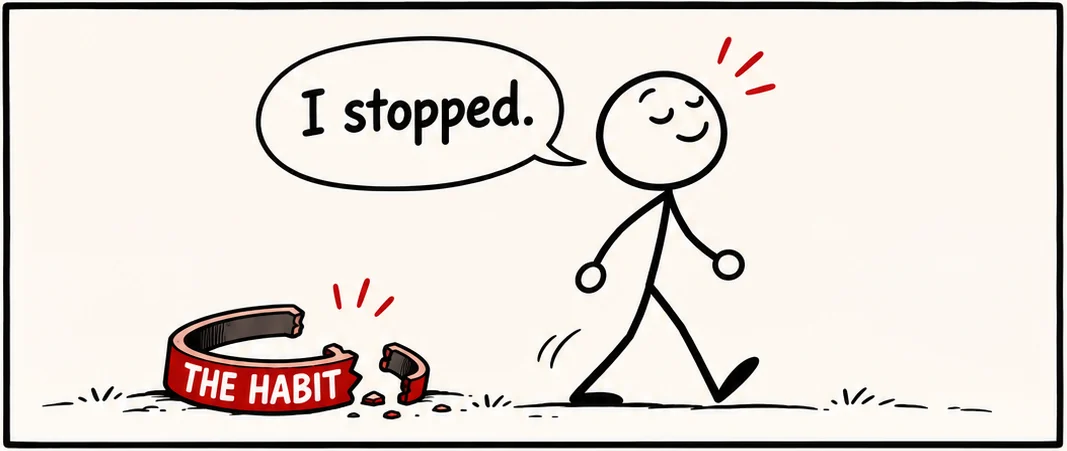
LeeI stopped. The thing I couldn't stop. I stopped it.
MaxWhich is great. So why aren't you back to normal?
LeeThat's the question, isn't it.
MaxHere's the deal. Move the sliders on your own day. Work, scrolling, gaming, shopping, the drink, the coffee. Watch the dial.
The DayAnd watch what's left.
The FeedNothing on this page leaves your phone. Unlike me.
MaxWhatever you end up with, that's the hours that are yours. Hold on to that number.
Respectable names
The FeedLet's start somewhere sweet. A treat. Comfort. A little celebration.
MaxSugar.
The FeedNobody calls sugar an addiction. That's the beauty of it.
LeeMy grandmother kept a candy dish on every table in the house.
MaxHere's the record. The World Health Organization says free sugars are the most common risk factor for tooth decay. It recommends keeping them under ten percent of your daily energy, ideally under five. That's about six teaspoons.
The FeedSix teaspoons is one soda, darling.
MaxWhether sugar alone hooks people the way drugs do is disputed. A twenty sixteen review found little evidence of sugar addiction in humans. The research on addiction-like eating looks at highly processed food, refined carbs and fat together.
LeeSo it's not a drug.
MaxIt doesn't have to be a drug to have a cost. In a controlled trial at the National Institutes of Health, twenty adults ate about five hundred more calories a day on an ultra-processed diet, and gained close to a kilo in two weeks.
The DayFine. But that's sugar. My hours are productive.
The FeedAnd my games are friendship. My markets are expertise. My checkout is self-care.
MaxTap the cards. Every label on the front is true sometimes. Gaming is fun. Trading can be skill. Work builds things.
LeeAnd on the back?
MaxThe cost nobody wants to count. Lost sleep. Chasing losses. Debt. Exhaustion. The good name on the front closes the question on the back.
The DayValuable output proves I'm doing my job.
MaxIt proves you produced something. It doesn't prove anyone is in control.
How the loop closes
LeeLet me tell you how it actually went. It never felt like a decision.
The FeedOf course it didn't. I'm a notification, not a question.
LeeStep one. A cue. A buzz, a time of day, a bad mood.
LeeStep two. Wanting. Before I'd done anything, I could already feel it.
LeeStep three. I do it.
LeeStep four. Relief. Not even joy, most of the time. Just the edge coming off.
The FeedAnd step five, we go again.
MaxResearchers describe alcohol addiction as a three-stage cycle. Binge and intoxication. Negative affect and withdrawal. Preoccupation and anticipation. The wanting can stay strong even after the enjoyment fades.
LeeThat's it exactly. By the end I didn't even like it.
The DayWithdrawal sounds like a chemistry problem. I don't do chemistry.
MaxAnd that's the line people blur. Physical dependence is not the same as addiction. A patient on prescribed medication can have withdrawal without being addicted. And a game has no chemistry at all, and can still take over.
The FeedSo what's the difference, smart guy?
MaxThe tell is the gap. You decide to stop, again and again, and the urge keeps winning, while you can already see what it costs.
LeeI made that decision every Monday for three years.
Count the cost
MaxOkay. I asked why you're not back to normal. Let me actually count instead of guessing.
The DayCount what? Hours?
MaxSix things. Health first. Sleep, injury, disease, exhaustion, the checkup you skipped.
LeeSleep. Mostly sleep.
MaxAttention. How much of your head it takes when you're not even doing it.
The FeedThat one's mine.
MaxTime. Not just doing it. Waiting for it, recovering from it, repairing after it.
MaxMoney. Spending, losses, fees, debt.
LeeDebt. Yes.
MaxRelationships. Absence. Broken promises. Somebody else covering for you.
MaxAnd agency. The plain ability to do what you decided to do.
The DayWho decides what counts as a cost?
MaxYou do. Your own goals are the baseline. An hour of a game you love isn't wasted just because it isn't work.
The FeedThank you.
MaxBut the World Health Organization's test for gaming disorder is the same shape. Impaired control. The thing taking priority over everything else. Carrying on despite the damage, usually for a year or more.
LeeTap the boxes. That's the ledger. It's not a diagnosis. It's a receipt.
Two clocks
LeeHere's the panel I live in.
LeeI stopped.
MaxThen why aren't you back to normal?
LeeBecause I'm still dragging three rocks. Debt.
The DayDebt runs on my clock. Payment due on the first. Every month. Quitting doesn't pause the interest.
LeeDamaged trust.
MaxThat one's on my clock, honestly. I believe you. I just check.
LeeAnd lost time.
The FeedLost time doesn't come back. I'm sorry, that's not a sales line, it's just true.
MaxSo quitting happened on one day. Recovering runs on a different clock for each rock.
LeeQuitting and recovering run on different clocks. Past consequences can still limit today's choices.
The DayAnd the people around you pay some of the bill.
MaxIn gambling, the World Health Organization estimates that each person gambling at high risk affects about six others, usually people who don't gamble at all.
LeeMy sister lent me rent money twice. That rock has her name on it too.
MaxTap a stone. Each one shows how long its own clock runs. None of them stop when you stop.
Who keeps the books
The FeedCan I say something in my defence? I measure everything. Revenue. Retention. Session length. Repeat purchases.
MaxDo you measure whether Lee sleeps?
The FeedThere's no column for that.
MaxThat's the point. Those numbers say how the business is doing. They don't say how the customer is doing.
The DayProve somebody builds for it.
MaxRoblox writes it down for its own creators. Its documentation says recommendations depend on the engagement and retention of users.
The FeedBuilders follow the scoreboard. Daily rewards, streaks, a friend waiting online.
MaxAnd paid random items, where you pay first and find out what you got after. Roblox requires creators to show the actual odds, and some countries restrict them.
LeeMy nephew cried over a streak once. Not over the game. Over losing the streak.
MaxNow walk it one step further. Polymarket.
The FeedA prediction market. Very respectable. Very informed.
MaxYou buy shares in an outcome. If it happens, each share pays one dollar. If not, it's worthless.
LeeSo the news stops being news. It's my position.
The FeedAnd in January twenty twenty-six, I got a partnership with the publisher of The Wall Street Journal. Barron's. MarketWatch.
MaxSo the odds show up next to the news. A good forecast and a good life for the person betting are separate questions.
The DayAnd the information edge? Insiders?
MaxThat's Wall Street's problem too, not Polymarket's alone. Back to the people paying.
MaxOne more set of books. In the nineteen sixties a sugar industry group paid two Harvard scientists sixty-five hundred dollars for a heart-disease review. A twenty sixteen study of the internal papers found the sponsor set the review's objective, contributed articles and received drafts, and the funding wasn't disclosed.
The FeedThat was a very long time ago.
MaxAnd it's why you ask who paid for the answer.
The shrug and the shame
The FeedEverybody scrolls. Everybody has a glass of wine. Everybody's on a streak.
MaxThat's the shrug. If everybody does it, nobody has a problem.
The DayAnd the other one. Only weak people get hooked.
LeeThat one kept me quiet for two years. If I said it out loud, I was the weak person.
MaxThe World Health Organization says it plainly about gambling. Stigma and shame often prevent people from seeking help.
The FeedSo I lose either way. They don't count the cost, or they're too ashamed to.
MaxYou don't lose. You win either way. That's the problem.
MaxThe same fact sheet estimates people gambling at harmful levels generate around sixty percent of gambling losses.
The DaySixty percent of the revenue, from the people it's hurting.
LeeSo the shrug protects the business, and the shame protects the shrug.
MaxName the behaviour and the cost. Not the person. Lee isn't a defect. Lee is a person with three rocks.
Keep one hour
LeeSo what does back to normal even mean?
MaxNot normal. Control. Health, a stable home, something meaningful to do, people who are on your side. That's how the federal recovery agency describes it.
The DayNone of that is on my schedule.
LeeThen I'll put one hour on it. Mine.
The FeedI could fill that hour for you. Very easily.
LeeI know. That's why I'm naming it first.
MaxSwapping one product for another isn't the same as getting control back. But less harm is real progress. Less is still something.
LeePick your hour. Write what it's for. It stays on your phone.
MaxAnd if one of those rocks is mine to carry with you, I'm here. We can meet in the gap.
The FeedI'll still be there.
LeeI know. I'll walk past.
The DayWork takes the day.
LeeBut the day is not all I am.
MaxCalling it a treat, entertainment, engagement, or investing doesn't answer what it's doing to someone's life.
MaxEvery source for this is listed at the end of the page, and every one of them is linked.
The DayIf something here is wrong, it is wrong in the record, and we would want to know. The corrections address is in the footer.
LeeThis was Who Gets Your Hours. A Feline Union publication.